

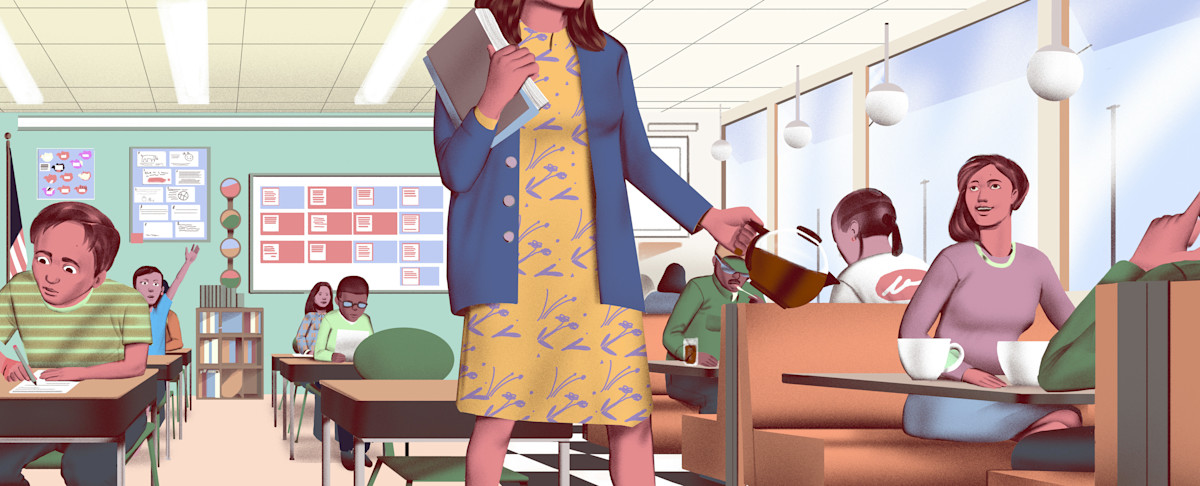
Nearly 1 in 5 American public school teachers work a second job outside of the classroom. Why is this their reality?
Just before her 16th birthday, Cara Rothrock got her first job working at a 1950s roadside restaurant and ice cream stand, only a few miles from her parents’ house in a small town in Floyd County, Indiana.
She poured soft serve. She cooked burgers and fries. She cleaned counters and took orders and ran food out to customers seated at picnic tables. All behind the glow of a bright, neon-lit parrot and a sign that read, “Polly’s Freeze.”

That was 1994. A few years later, Rothrock went off to college in Bloomington, Indiana. And because her parents—both teachers—couldn’t afford to help out much with her expenses, she held onto her job at Polly’s, commuting two hours home on weekends to pick up shifts. She spent the money as she earned it, investing in her education so that she could pursue her dream of becoming an elementary school teacher, just like her mom and dad before her.

After graduation, she landed a teaching position close to home. But with a starting salary of $29,000 and nearly that much in student loans, she didn’t feel comfortable enough financially to leave Polly’s. Not yet.
“As I tried to get a house of my own, a car, I found that, as a teacher, there was really no choice. I kind of needed to work a second job,” she explained in January from her third grade classroom at a public school near her hometown.
And anyway, it was a great job for young people, Rothrock said of Polly’s. Nearly Rothrock didn’t intend to stay at Polly’s forever, watching generations of teenagers cycle in and out of a job that she was never able to walk away from herself. Back when she was starting out as a teacher, she had to work a second job just to get on her feet. Then she got married and started a family. By the time her student loans were paid off, she had added She could quit Polly’s today, she said, and her family could make it. “But there wouldn’t be anything extra,” she added. The emergency fund would be meager, if it existed at all. Would her 13-year-old be able to get the braces she needs? Could they have replaced the refrigerator when it went out, or saved to put a new roof on the house this summer? Could she have repaired the car when it broke down a few months ago, costing her family $3,000 they didn’t really have, even with income from Polly’s? Rothrock’s story is not exceptional—at least in her line of work, in this country. If she were any other highly educated American professional, that might be different. But Rothrock is a teacher. That a teacher must work a second, part-time job on weeknights and weekends, year-round, more than 20 years into her career, in spite of a master’s degree and a modest lifestyle, is so universally accepted among her peers and colleagues in education that it barely warrants notice. All 30 teachers I interviewed for this story have at least one other job outside of the classroom and many have other paid roles within the school, too. All of them know of colleagues down the hall and throughout the school building who work second jobs. Some work in retail, run Etsy shops or bartend. Others work at Home Depot, in pharmacies or as house cleaners. Swati Linder, a band teacher who works at a middle school outside of Charleston, South Carolina, said that when she first started dating her now-husband, she asked him, “So what else do you do?” Confused, he clarified, “I’m a teacher.” She replied, “‘And?’” “It’s so commonplace,” said Linder, who doubles as a real estate agent. Colleagues in her school district work at Walmart; deliver food through DoorDash; and sell products for multi-level Within the profession, it’s a fact of life author of the 2018 book, “By the Light of the Silvery Moon: Teacher Moonlighting and the Dark Side of Teachers’ Work,” and a professor at Western Carolina University “Teacher moonlighting is like some dirty little secret that we all know about, we talk about, teachers share ideas about, but nobody wants to put it on the table—that we work at Steak ‘n’ Shake or these other places,” said Blair, a former public school teacher who used to moonlight as a waitress.


